WORK
Visier Prototypes
Simplifying a complex data workflow into a self-service experience—navigating ambiguity and stakeholder conflict to ship for the right user
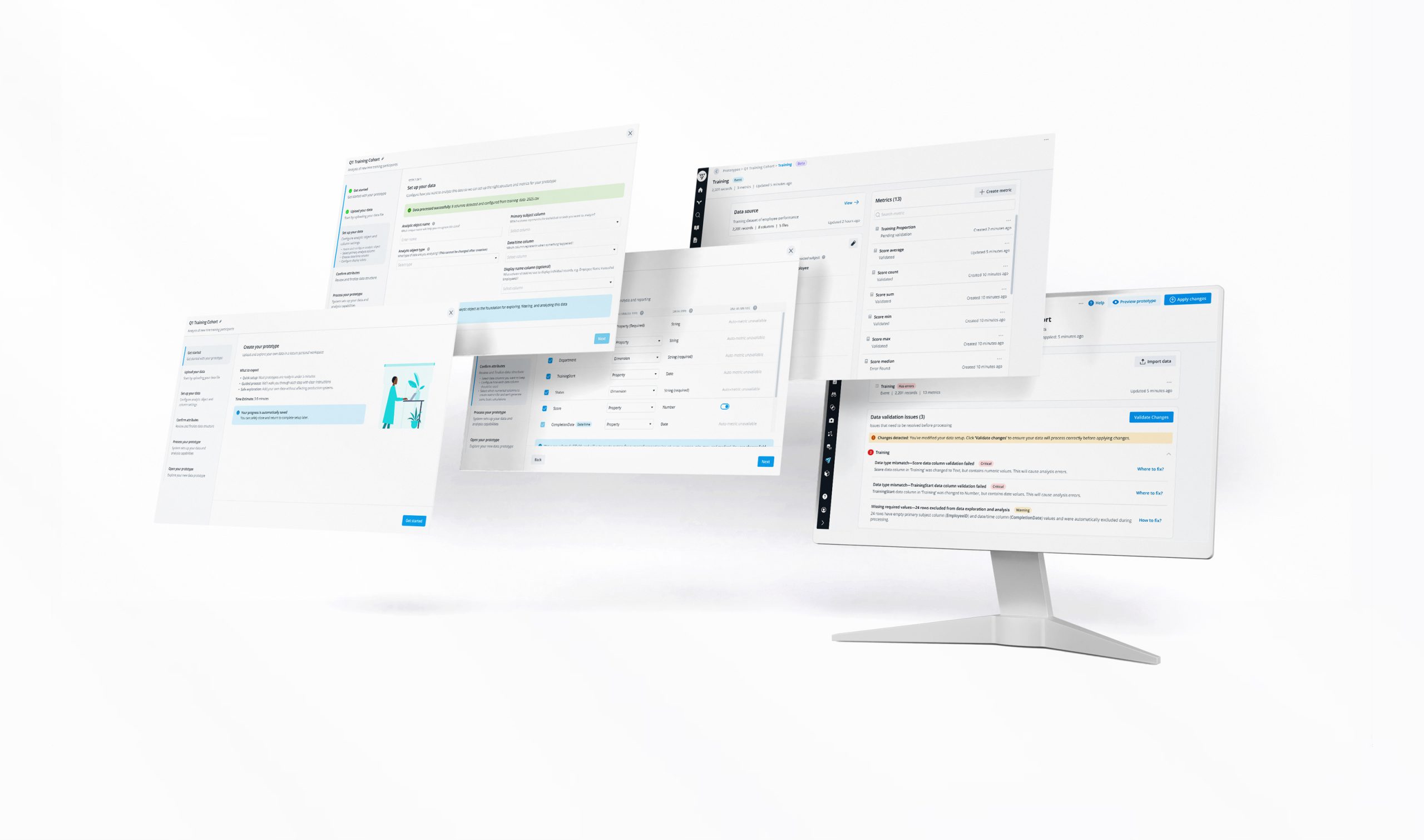
MEDIUM
Enterprise SaaS / Web App
DELIVERABLES
UX, UI
PROJECT ROLE
Lead UX Designer
Project overview:
Visier is a people analytics platform used by enterprise HR and people teams. It has two distinct sides: Studio, where admins and technical specialists configure and model data, and Visier People, where everyday business users explore reports and workforce insights.
Getting new data into the platform has always been a slow process—it goes through Studio, requires admin involvement, multiple steps, and often weeks of back-and-forth. If a manager wanted to analyze something that wasn’t already in the system, someone else had to do it for them.
Prototypes is a self-service sandbox that changes that. It lets business users upload their own external data and run analyses alongside Visier’s existing production data—without needing to involve the admin team every time.
I led UX on this feature end-to-end: from an ambiguous brief with no defined audience, through customer research, a high-stakes architecture decision, design and validation, and into our Limited Availability beta launch. Phase 2 is ongoing.
Goals
The central challenge wasn’t technical—it was strategic. The loudest voice in the room wanted to build this for power users who already knew the platform deeply. Research pointed in the opposite direction.
The beta was a learning exercise with two critical unknowns: whether a simplified experience could provide enough analytical flexibility for line managers, and whether line managers were even the right audience at all. Success wasn’t defined by features shipped—it was defined by what the data told us afterward.
Customer Problems
The pain wasn’t hypothetical. Across customer interviews, we kept hearing the same things:
“Every time I need to look at new data, I have to submit a request and wait. It can take weeks.”
— HR Manager
“I end up exporting to Excel because it’s just faster.”
— HR Analyst
“I don’t want to pull my team into Studio—they’d have to learn a whole new interface.”
— People Analytics Team
The pattern was consistent: business users had data sitting in spreadsheets and CSVs that they couldn’t get into Visier without going through an admin. So they worked around it—manually, in tools they already knew, disconnected from the rest of their analytics.
The bottleneck had real consequences. Time-to-insight for new data was measured in weeks. The admin team carried the burden of every data request, regardless of complexity.
Business Problems
Visier’s broader strategy—enabling more users to expand the data available in the platform—couldn’t move forward if every new dataset required a technical specialist to onboard it. But the problem ran deeper than a missing feature.
This had been attempted twice before and hadn’t shipped. Internally, there was a persistent belief that Visier’s data modelling process was simply too complex to distill into something both accessible and analytically meaningful—that ease and usefulness were fundamentally at odds.
Meanwhile, the gap was showing up in sales conversations. Even after substantial investment in Visier, customers were still reaching for Tableau or Power BI for ad hoc analysis. The platform wasn’t fully replacing the tools it was meant to.
Prototypes was the answer to that bottleneck. But only if it was built for the right people.